

 Do temper tantrums anger or frustrate you? They used to make me feel like an inadequate mother.
Starting with Justine’s first few temper tantrums 11 years ago—which I felt ill equipped to deal with—I started searching for and reading information to help me understand how to handle my children’s unwanted behaviors.
My search led me to several books—the first being 1-2-3 Magic. All of the different author’s techniques were ineffective for me and I’ll explain why over the next few days.
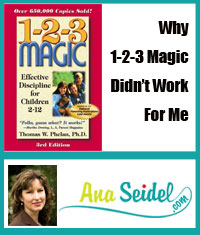
1-2-3 Magic: Effective Discipline for Children 2-12
The first program I tried was from the book, 1-2-3 Magic by Thomas W. Phelan. I liked the premise. By using numbers after asking a child to stop a behavior, you give them the opportunity to choose to control their behavior.
“That’s 1” is the child’s alert
“That’s 2” is the child’s final decision making opportunity
“That’s 3, you’re out.” the child has reached the limit and is off to time-out.
It seemed to work as long as Cory and I worked the system.
But over the months we grew weary of counting and sending our kids to their rooms.
What I Know Now and Why It Doesn’t Work Longterm
Cory and I felt like our kids were not internally making choices to behave nicely.
We were the outside force continually asking them to stop by counting! The whole point of parenting is to help your children grow into adults who can think for themselves.
The 1-2-3 technique can be very effective for 2 and 3 year olds, but if you think about it, why are the twos and threes so difficult?
Because they are separating from their parents—they are learning how to be an individual. And an individual wants to make their own choices.
As children get older, especially years 4-12 they need to be given the choice to learn to make positive behavior choices on their own. A parenting technique that requires you to have to count everything that is an unwanted behavior does not develop internal behavior choices.
Children need to learn to be Responsible, Respectful, Helpful, Kind, Cheerful and Honest. They have to choose those behaviors on their own.
What About You?
Has 1-2-3 Magic been difficult for you?



{ 2 comments… read them below or add one }
I am so glad you wrote this article. I too have some thoughts on this 1, 2, 3 magic method as well. I am a Social Worker, and Developmental Specialist. I provide workshops, trainings and consults to Early Childhood educators and Parents of children birth to age 5.
I do not like this method for young children. I do agree that adults should not have to ask a child to do something or stop something a million times. I also agree that if a child chooses to not listen there should be a consequence. The problem with this method is that there is no teaching moment happening during the event.
I teach that Discipline means teaching children what and why things are not ok, and we teach them solutions, and how to make better choices. If I just start counting to three I am assuming the child already knows what they are doing wrong, they know how to stop, and they know how to come up with a better choice. This is not always the case for young children.
I prefer to tell children two ‘yeses’ for every ‘no’. This teaches children at least two other better choices. With this modeling the child will start to learn to come up with their own better choices.
I do my own version of 3 times your out. First I tell them the No with Yeses. Then if the child continues I remind them of the yeses then I tell them what the logical consequences will be if they do not listen. Then 3rd time, consequence happens.
I am so gad that there are others who share in my views!
Thanks again!
Thank you so much for your insightful comment! I love your thought that counting assumes that a child knows they are doing an unwanted behavior. For them, the world is a playground and they need to try everything to gain “experience.” A lot of the things that parents consider unwanted behavior is darn fun!
Keep up your great work!
Ana